

News Details
Double Tie Rod Bellows Expansion Joints Design Parameters & High Pressure Pipeline Matching Scheme
Author: huajie Date: 2026-06-16 16:33:38 Views: 88
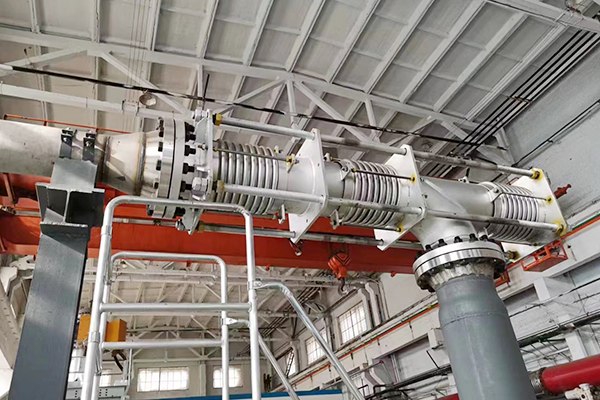
In petrochemical,high-pressure thermal power and coal chemical long-distance transmission pipelines,the medium pressure often reaches PN16,PN25 and even PN40 high pressure grades.Ordinary single tie rod expansion joints can only limit the unidirectional axial displacement of the bellows,and cannot offset the two-way blind plate thrust generated by high-pressure medium,which is easy to cause unilateral tensile damage of the metal bellows.Double Tie Rod Bellows Expansion Joints are equipped with two groups of independent symmetrical tie rod assemblies on both sides of the bellows,each group of tie rods can bear the blind plate force in the opposite direction of the pipeline,limit the maximum stretching and compression stroke of the bellows at the same time,and can absorb the lateral horizontal displacement and small-angle torsion of the pipeline.This two-way limit structure makes double tie rod bellows expansion joints become the designated matching compensation component for all kinds of high-pressure bidirectional displacement pipelines,and is widely used in high-temperature high-pressure steam main pipelines,chemical high-pressure crude oil transmission pipelines and hydrogen production process pipelines.
The core structural difference between double tie rod bellows expansion joints and other tie rod type compensation devices lies in the double independent tie rod limit system.The main tie rod expansion joint only sets one group of main load-bearing tie rods,which can only resist the blind plate force in a single direction,and is suitable for pipelines with fixed displacement direction;the single tie rod expansion joint has only a small number of auxiliary limit tie rods,which cannot bear large pressure load,and is only used for low-pressure small-diameter pipelines;the double tie rod product is provided with front and rear two groups of tie rod frames along the pipeline axial direction,each group of tie rods is composed of multiple high-strength alloy steel pull rods,and the adjustable limit nuts are arranged at both ends of the tie rod.When the pipeline medium pushes the bellows to stretch forward,the front group of tie rods bears the tension load;when the pipeline thermal contraction pulls the bellows to compress backward,the rear group of tie rods bears the reverse tension load,realizing two-way stress protection of the bellows.In terms of bellows main body,double tie rod expansion joints mostly adopt multi-layer thick-wall stainless steel hydraulic forming structure,and the wall thickness of single layer bellows is thicker than ordinary compensation joints,which improves the anti-pressure impact performance of the flexible part,and matches the high load bearing capacity of double tie rod groups.
The design parameter system of double tie rod bellows expansion joints covers four core dimensions:nominal pressure grade,pipeline nominal diameter,reserved compensation displacement and tie rod group bearing capacity.The nominal pressure range of conventional finished products covers PN6-PN40,and customized ultra-high pressure products can reach PN63 by adopting alloy thick-wall bellows and high-strength chromium-molybdenum steel tie rods.The design of the number of bellows waves is directly linked to the axial compensation displacement required by the pipeline.Each wave of stainless steel bellows can bear a limited expansion and contraction distance,and the double tie rod structure allows the bellows to set more wave numbers,so the single product can realize larger axial compensation amount without increasing the length of the pipeline section.The diameter of the tie rod is calculated according to the blind plate force generated by the pipeline cross-sectional area and medium pressure.The higher the pressure and the larger the pipe diameter,the larger the required tie rod diameter and the more the number of single-group tie rods.Many small manufacturers reduce the diameter of the tie rod and reduce the number of tie rods in order to reduce production costs,resulting in the tie rod being stretched and deformed during the pipeline pressure test,and the bellows loses limit protection and bursts,causing serious medium leakage safety accidents.Therefore,when purchasing double tie rod expansion joints,enterprises must ask manufacturers to provide tie rod load bearing calculation data and material tensile test reports.
According to different medium corrosion characteristics,double tie rod bellows expansion joints are divided into stainless steel conventional type and PTFE lined anti-corrosion type two major series.The stainless steel conventional type bellows uses 304 or 316L stainless steel as raw material,and the tie rod surface is hot-dip galvanized for anti-rust treatment,which is suitable for high-pressure steam,clean circulating water and neutral oil medium pipelines without strong corrosion components.The PTFE lined double tie rod expansion joint adds a whole layer of polytetrafluoroethylene lining inside the bellows,which completely isolates the contact between acid,alkali,salt and other corrosive media and the metal bellows matrix,and the outer double tie rod group still maintains the two-way pressure limit function,which is specially used for high-pressure chemical pipelines transporting hydrochloric acid,nitric acid and brine.In high-temperature working conditions above 400℃,the tie rod needs to be upgraded to 321 high-temperature resistant alloy steel,and the surface is coated with anti-oxidation high-temperature paint to avoid the softening and strength reduction of the tie rod under long-term high-temperature radiation.
The on-site installation and pressure test specifications of double tie rod bellows expansion joints have strict requirements for support layout and temporary limit disassembly sequence.Before hoisting,both groups of front and rear tie rod limit nuts are locked in the factory state,which is a temporary fixing measure to prevent the bellows from being damaged by random stretching during transportation.After the expansion joint is welded between the two pipe sections,two fixed supports must be installed within 1.5m of the front and rear sides of the compensation joint,and all sliding supports in the pipeline section are adjusted in place.Only after the fixed support bears all the axial blind plate force of the pipeline can the two groups of tie rod limit nuts be loosened to the reserved displacement scale marked by the factory.If the limit nut is loosened in advance without fixed support protection,the bellows will bear all the high-pressure blind plate force alone,resulting in permanent stretching deformation and failure.The pipeline pressure test shall be carried out step by step by graded pressure boost.The first stage boosts to 50%of the test pressure for pressure maintaining inspection,and after confirming that there is no looseness of tie rod nuts and no leakage of welding seams,continue to boost to 90%of the test pressure for long-term pressure maintaining observation.During the pressure maintaining period,it is necessary to check whether there is lateral bulging deformation on both sides of the bellows,which is an early warning signal of insufficient tie rod bearing capacity,and the pressure test must be stopped immediately to replace the high-specification double tie rod expansion joint.
In the daily operation and fault maintenance work of high-pressure pipelines,the common failure problems of double tie rod bellows expansion joints mainly include tie rod thread sliding teeth,bellows lateral offset bulging and flange sealing surface leakage.The thread sliding of the tie rod is mostly caused by the unqualified tensile strength of the tie rod material or the excessive displacement impact of the pipeline,and the solution is to replace the high-strength alloy steel tie rod group and re-adjust the pipeline support to reduce the instantaneous displacement impact;the lateral bulging of the bellows occurs when the lateral sliding support of the pipeline fails,resulting in excessive unilateral lateral force on the compensation joint,and it is necessary to increase the lateral limit sliding support and correct the offset pipeline;the leakage of the flange sealing surface is caused by the aging of the asbestos rubber gasket under long-term high pressure and high temperature,and the high-pressure resistant metal wound graphite gasket can be replaced to enhance the sealing performance.In the regular maintenance work,the maintenance personnel need to regularly wipe the thread part of the tie rod and apply anti-rust lubricating grease to prevent the thread from rusting and being unable to adjust the limit displacement later.It is forbidden to cut off any group of tie rods without design approval,which will destroy the two-way stress balance structure of the compensation joint and lead to bellows damage under high pressure.
From the perspective of pipeline system design economy,double tie rod bellows expansion joints can simplify the layout of pipeline fixed supports and reduce the number of heavy-load fixed supports required for high-pressure pipelines.A single double tie rod compensation joint can bear the two-way blind plate force of the front and rear pipeline sections,so it is not necessary to set multiple reinforced fixed supports near the compensation joint like unconstrained expansion joints,which reduces the civil engineering construction cost of the support foundation.At the same time,the double tie rod product integrates axial and lateral multi-dimensional compensation functions,and a single device can replace two sets of single-function expansion joints,reducing the number of pipeline accessories and the difficulty of later maintenance and management.Its only shortcoming is that the overall manufacturing length and weight are larger than single tie rod products,and the procurement cost is slightly higher,which is acceptable for long-term stable operation of high-pressure pipelines,and the comprehensive cost saved by reducing support investment and failure shutdown losses can offset the early procurement difference.
To sum up,Double Tie Rod Bellows Expansion Joints are special high-pressure compensation products developed for bidirectional displacement high-load pipeline working conditions.The double-group symmetrical tie rod two-way limit structure is its core technical advantage,and all design,selection,installation and maintenance links need to focus on the matching between tie rod bearing capacity and pipeline medium pressure parameters.Pipeline design institutes,petrochemical engineering companies and pressure vessel supporting manufacturers need to fully master the parameter design standards and fault troubleshooting methods of double tie rod expansion joints,so as to reasonably match compensation equipment for high-pressure process pipelines,eliminate hidden dangers of bellows burst and medium leakage caused by blind plate force,and improve the long-term safe operation stability of industrial high-pressure transmission pipelines.
 Recommended Products
 CONTACT
—— Hotline:+86 18932765800
—— Email:hj18932765800@gmail.com
—— Whatsapp:+8618932765800
—— Address:Industrial Zone, Botou City, Hebei Province